
Modern security, border monitoring, and military operations increasingly encounter tactical environments where traditional visual imagery completely fails. Dense fog, wildfire smoke, dust storms, atmospheric humidity, and sophisticated camouflage routinely blind standard optical and thermal sensors. To bridge this critical visibility gap, defense agencies, maritime authorities, and commercial intelligence providers are rapidly adopting Short Wave Infrared technology to maintain unbroken situational awareness.
What is Short Wave Infrared (SWIR)?
Short Wave Infrared (SWIR) occupies the light spectrum between 1,000 nm and 2,500 nm; positioned directly between visible light and thermal radiation. Unlike thermal infrared sensors, which measure emitted heat differentials, SWIR sensors detect reflected photons, functioning much like high-resolution visible-spectrum cameras.
However, because SWIR wavelengths are significantly longer than visible light, they interact with atmospheric particles and chemical compositions in unique ways:
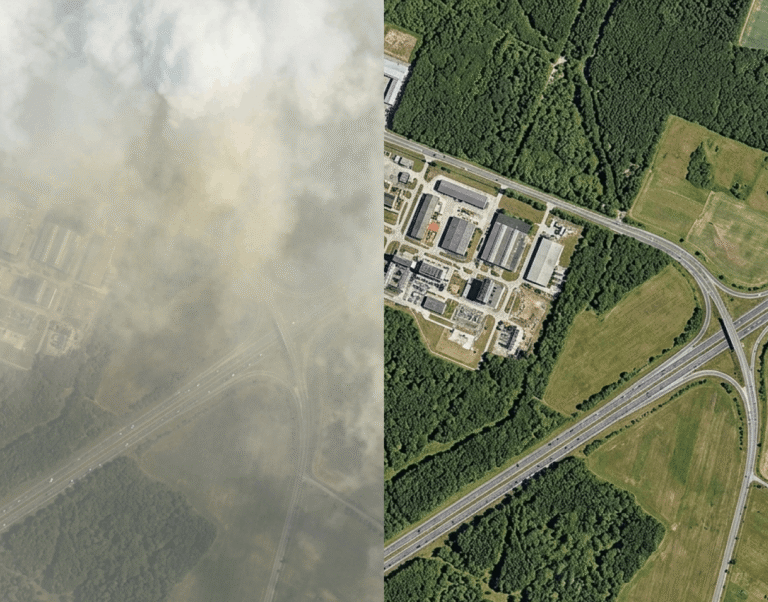
- Particle Penetration: Shorter light waves reflect off small airborne particulates, creating glare and blur. Longer SWIR wavelengths pass straight through dense haze, smoke, fog, and dust.
- Chemical & Spectral Discrimination: Materials with identical colors in the visible spectrum often have vastly different absorption spectra in SWIR, exposing material properties invisible to the naked eye.
- Glass Transparency: Unlike long-wave thermal sensors, SWIR wavelengths travel through standard optical glass, allowing sensors to look directly through building windows or vehicular windshields.
- Night Airglow Utilization: SWIR sensors capitalize on night sky radiance (atmospheric airglow) to capture crisp images in near-total darkness without needing active illumination.
Operational Scenarios: SWIR for Security in Action
Implementing SWIR for Security gives ISR (Intelligence, Surveillance, and Reconnaissance) teams a crucial verification layer. Standard visual sensors show what a target looks like; SWIR reveals what it is made of.
[Visible Light] ──> Blocked by haze/smoke ──> Target Obscured
[Thermal (LWIR)] ──> Shows heat profile ──> No material detail
[SWIR Spectrum] ──> Pierces atmosphere ──> Reveals material signature & detail
Real-World Defense & Security Use Cases
- Camouflage & Decoy Exposure: Military netting and inflatable decoys are visually color-matched to surrounding terrain. In the SWIR band, natural chlorophyll in live foliage strongly reflects light, while synthetic materials absorb it. Camouflaged positions light up as distinct anomalies instantly.
- Border Security & Ground Disturbance Detection: Unauthorized crossing routes often involve improvised tracks and staging areas away from official checkpoints. SWIRSAT’s moisture-sensitive band (1415nm) picks up soil disturbance and ground preparation signatures invisible to standard optical imagery, while its material-discrimination band flags camouflaged or artificial structures used to conceal staging points. This helps border agencies identify unauthorized corridors and infrastructure for follow-up investigation.
- Wildfire Mapping & Post-Fire Assessment: Thick smoke plumes blind standard optical and thermal cameras during active fires, hiding the fireline itself. SWIRSAT’s bands are tuned for smoke penetration, letting analysts map active burn edges and fire perimeter extent even when visible-spectrum imagery is fully obscured. This gives incident commanders faster situational awareness during and after a fire event.
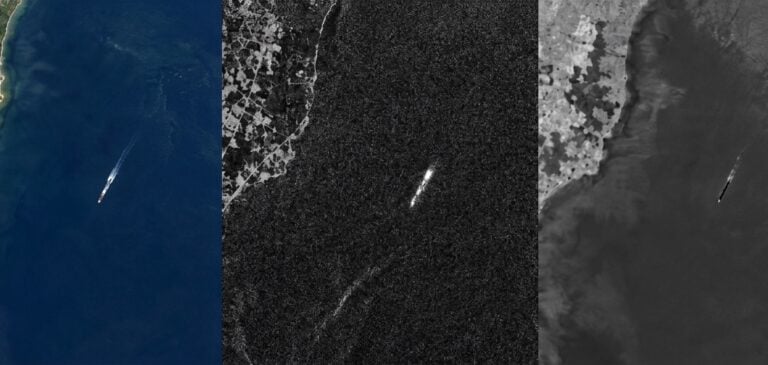
- Maritime Domain Awareness in Degraded Conditions: High humidity, sea spray, and coastal haze routinely degrade optical maritime surveillance. SWIRSAT sustains usable imaging performance through these marine boundary layers, supporting vessel detection, classification, and wake-pattern analysis, including vessels operating with AIS disabled or spoofed. This strengthens maritime domain awareness when fused with AIS, RF, and radar data.
- Ground Disturbance & GEOINT Analysis: Excavation, construction, and other ground disturbance activity produce distinct soil moisture signatures. SWIRSAT’s 1415nm band detects these anomalies, helping analysts flag unrecorded excavation or unusual ground preparation for further investigation. This is a cueing capability that works alongside, not in place of, ground-based methods for confirming point-target hazards.
Technical Comparison: Optical vs. Thermal vs. SWIR
Sensor Capabilities
| Sensor Capability | Visible Optical | Thermal (MWIR/LWIR) | Short-Wave Infrared (SWIR) |
| Through-Smoke/Haze Penetration | Low, scattering blocks the signal | Medium, degrades in dense smoke | High, reduced atmospheric scattering, though dense black smoke can still attenuate it |
| Night/Low-Light Imaging | Low, requires ambient light | High, detects heat regardless of light | Low, passive solar-reflectance sensor, no usable imagery at night |
| Material Identification | Medium, limited spectral information | Low, detects heat only, not material composition | High, spectral bands tuned to material and moisture signatures |
| Camouflage & Concealment Detection | Low, visually deceived by camouflage | Low, camouflage often thermally matched to surroundings | High, detects material properties camouflage can’t mask |
| Structural/Asset Resolution | High, native VNIR-class resolution | Low, coarser thermal resolution, limited detail | Medium, native 8m/4m Super HD, strongest when co-registered with VNIR |
Persistent Orbital Intelligence: SWIRSAT by LC60
While tactical aircraft and drone-mounted SWIR sensors are effective locally, continuous strategic surveillance requires persistent space-based capability. This is where SWIRSAT by LC60 (LatConnect60) represents a critical leap forward.
SWIRSAT by LC60 is a specialized Earth observation constellation engineered to deliver persistent, decision-grade geospatial intelligence at scale. By deploying high-resolution, multi-spectral SWIR payloads into low Earth orbit (LEO), LC60 enables continuous, uninhibited monitoring across remote, contested, or climate-compromised regions.
Strategic Capabilities of SWIRSAT:
- Sub-4m High-Resolution Imagery: Captures fine-grained SWIR telemetry across regional tactical zones previously only accessible via high-altitude aircraft.
- On-Board AI Processing: Filters raw data and executes threat-detection algorithms directly on the satellite, drastically reducing downlink latency for time-critical alerts.
- Global Monitoring of Critical Infrastructure: Monitors oil pipelines, maritime choke points, and defense installations globally without relying on ground-based visual clearance.
- Sovereign Interoperability: Designed for integration across NATO, Five Eyes, and Indo-Pacific defense intelligence architectures.
By combining persistent orbital monitoring from space-based platforms with ground-level security operations, SWIR technology ensures defense forces maintain an unyielding operational edge; day or night, in any weather.
Decisions that matter deserve intelligence that delivers.
Speak with our solutions team to explore how LC60 can support your mission.