Verified Credits. Trusted Data.
LC60 delivers digital Monitoring, Reporting, and Verification (MRV) for agricultural and nature-based carbon credit programmes — combining satellite observation, on-ground data, and AI analytics into an auditable credit lifecycle.
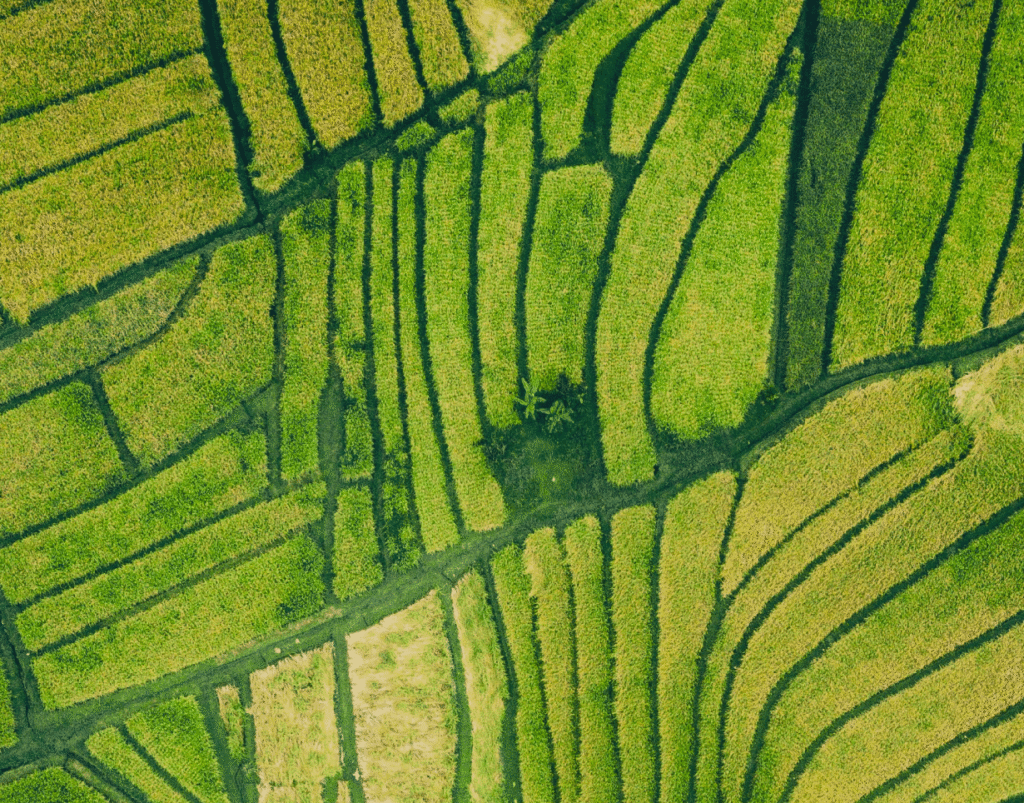
The voluntary carbon market has a credibility problem.
Buyers want assurance. Regulators want auditability. Project developers need scalable verification that doesn’t collapse the economics. LC60 closes the gap with satellite-based digital MRV — providing independent, repeatable evidence of emission reductions across rice cultivation, forestry, and other land-use programmes.
From smallholder action to verified credit.
A three-step lifecycle combining mobile, in-field, and orbital intelligence.
Farmer Onboarding
Mobile-based registration, project enrolment, and activity guidance delivered directly to smallholders in local language.
Activity Logging
Field actions recorded in-app — alternate wetting and drying, residue management, fertiliser optimisation — with photo and geotag evidence.
Satellite Verification
SWIRSAT and partner satellite data independently verify on-ground activity, flooding patterns, biomass burning, and crop conditions.
A continental opportunity.
LC60 estimates an addressable opportunity of over 45 million hectares of rice and paddy cultivation across ASEAN — representing more than 135 million tonnes of CO₂-equivalent emission reduction potential annually.
- Rice & paddy cultivation across ASEAN
- Independent satellite verification
- Auditable credit lifecycle
- Compatible with major registry standards
Common questions
MRV (Monitoring, Reporting, Verification) is the credit-lifecycle backbone of every carbon market. Legacy MRV relies on infrequent field audits, paper records, and self-reported activity data — which is slow, expensive, and exposed to fraud. Digital MRV replaces that with continuous satellite observation, mobile-captured field evidence, and AI analytics, producing an auditable record that registries and buyers can independently verify.
LC60 is designed to align with major voluntary registries (Verra/VCS, Gold Standard, Plan Vivo) and national compliance frameworks. The platform records the inputs that each methodology requires, in the structure that registry verifiers expect — so the verification cycle is shorter and the failure modes are clearer.
Independent orbital evidence of land cover, biomass, and management activity means that a credit’s underlying claim can be challenged or confirmed remotely, at any time, by any party with access to the satellite record. That changes the economics of bad credits — they become detectable rather than hidden — which is the main reason buyers are starting to require digital MRV in offtake contracts.
Our primary focus is agricultural and nature-based programmes in the Asia Pacific — particularly rice methane reduction under AWD (Alternate Wetting and Drying), agroforestry, and avoided peatland degradation. LC60 estimates an addressable opportunity of 45+ million hectares of paddy across ASEAN alone, representing 135+ million tonnes of CO₂-equivalent reduction potential annually.
AWD requires fields to be drained and re-flooded on a defined cycle, which materially reduces methane emissions versus continuous flooding. SAR and SWIR satellite data can detect surface water presence at field scale on a near-daily basis — meaning we can verify that an enrolled field actually followed the AWD schedule, rather than relying on farmer or aggregator attestation.
Onboarding is done through local aggregators and extension networks using a mobile workflow — geo-tagging field boundaries, capturing baseline practice, and recording management activity. Incentive payments are channelled through the same aggregators on a verified-activity basis, so farmers are paid only when the satellite and field record agree.
From signed agreement to first verified credits typically takes one full growing or monitoring cycle — for rice, that is roughly 4–6 months end-to-end. The longest single dependency is usually farmer enrolment and baseline establishment, not the satellite or analytics work.
Carbon you can verify. Credits you can trust.
Speak with our carbon team to scope an MRV programme for your project pipeline.